Get 10% off your first order! CODE: FIRSTORDER10



Pain to Power: Mastering the Biomechanics of the High Bar Back Squat
Stop letting lower back pain stall your progress. Dive into the biomechanics of the high bar back squat with Muscle Munchies. We break down the phases of movement, torque generation, and injury prevention to help you move better, train harder, and fuel your gains with confidence.
PROTEIN BALLS 101
Ben
1/31/20263 min read
Pain to Power: A Biomechanical Breakdown of the High Bar Back Squat
Many athletes view the back squat as the "King of Exercises," but for those struggling with chronic injury, it can feel like a daunting hurdle. Take the case of a lifter we’ll call Alex. For five years, Alex battled persistent lower back pain. Traditional advice—walking more, regular massages, and posture correction—offered only fleeting relief.
The turning point wasn't rest; it was a technical shift to the high bar back squat. By resting the bar higher on the trapezius, Alex found an upright position that built the spinal stability necessary to finally alleviate years of discomfort.
Below, we break down the biomechanics that make this movement both a powerful strength builder and a tool for longevity.
The Fundamentals: Plane and Setup
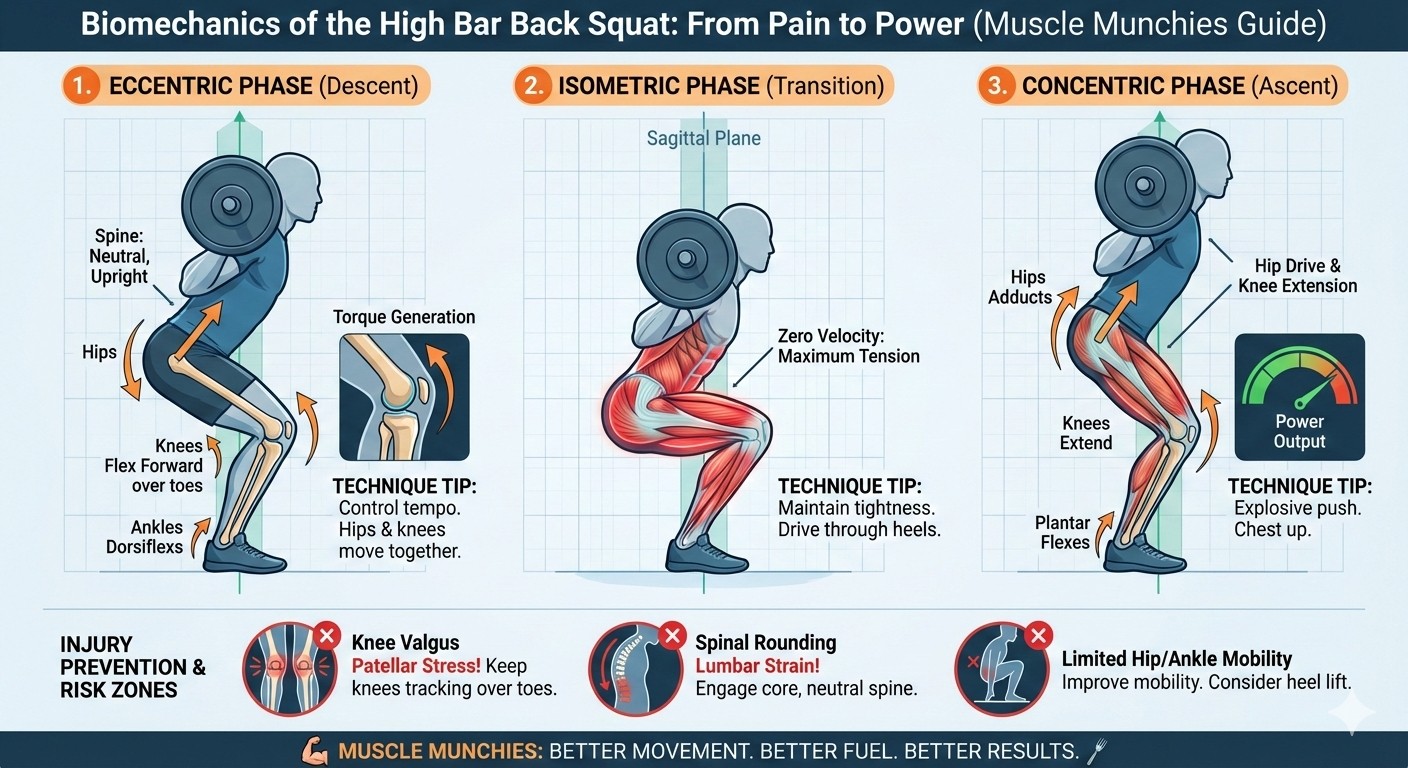
The back squat occurs primarily in the sagittal plane. To execute it safely, the spine, hips, knees, and ankles must work in harmony. Proper alignment is paramount; as the knees flex, the hips must transition back and down to maintain the center of gravity.
The Perfect Setup
Stance: Feet should be slightly wider than shoulder-width.
Toe Angle: Toes pointed forward or slightly flared (no more than 10 degrees).
Grip: Hands hook the bar with flexed elbows to create a stable "shelf" on the upper back.
Load: Whether training for muscular strength (heavy loads) or muscular endurance (lighter loads), the priority remains stabilization and movement quality.
The Physics of the Lift: Torque and Kinematics
When a lifter engages their muscles, they aren't just "moving weight"—they are generating torque around the joints to overcome gravity.
Angular Kinematics play a vital role here. As the lifter descends, the angles of the hip, knee, and ankle shift constantly. If these angles deviate—for instance, if the knees cave inward—the application of torque becomes inefficient, placing dangerous stress on the connective tissues.
Pro Tip: If a lifter has a limited range of motion in their ankles, placing a small plate under the heels can assist in achieving proper depth while maintaining a neutral spine.
Managing Risk and Preventing Injury
Even the best exercises carry risks if performed with poor mechanics. Here are the three "Red Zones" to watch:
The Knee (Patellar Stress): Allowing the knees to collapse inward (valgus) can lead to patellar tendonitis, or "jumper’s knee."
The Lumbar Spine: Rounding the back or leaning too far forward under heavy loads can cause herniated discs or severe strains.
The Hips: Excessive depth without adequate mobility can lead to labral tears or impingement.
The Three Phases of Movement
Understanding the squat requires breaking it into three distinct mechanical phases:
Eccentric, the descent hips abduct and move back/down. Knees flex and move toward the toes (dorsiflexion).
Isometric, the transition zero velocity at the "bottom." Muscles generate immense tension to stabilize the load.
Concentric, the ascent, the "explosive" phase. Pushing through the heels and extending the knees to return to standing.
Related guides
Best Pre-Workout Snack: /blog/pre-workout-snack
Post-Workout Snacks: /blog/CaAKG
Storage Guide: /blog/store-protein-balls-thailand
FAQs
Are protein balls healthy? They can be a practical snack when made with simple ingredients and eaten in sensible portions.
Are protein balls good before the gym? Yes, many people use them 30–60 minutes before training.
Do protein balls replace a meal? Usually no — they’re best used as a snack.
Do protein balls need refrigeration? It depends — follow the brand’s storage guidance and your local conditions.
The Muscle Munchies Standard
The journey from chronic pain to peak performance isn't just about trying harder; it’s about training smarter. Alex’s story illustrates the profound impact that effective biomechanics can have on your training longevity.
At Muscle Munchies, we believe that understanding the why behind the movement is just as important as the movement itself. We are here to deliver the highest quality advice and technique on movement, exercise, and nutrition. Whether you're looking to fix your form, optimize your recovery, or fuel your next PB, we’ve got you covered.
Better movement. Better fuel. Better results.
"Crush Your Cravings"
Muscle Munchies Protein Balls
Healthy snacks for active lifestyles and fitness.
Contact
+66897246744
© 2026. All rights reserved.
76/9 M.6 T.Chanlong A.Muang, Phuket, Thailand 83130